
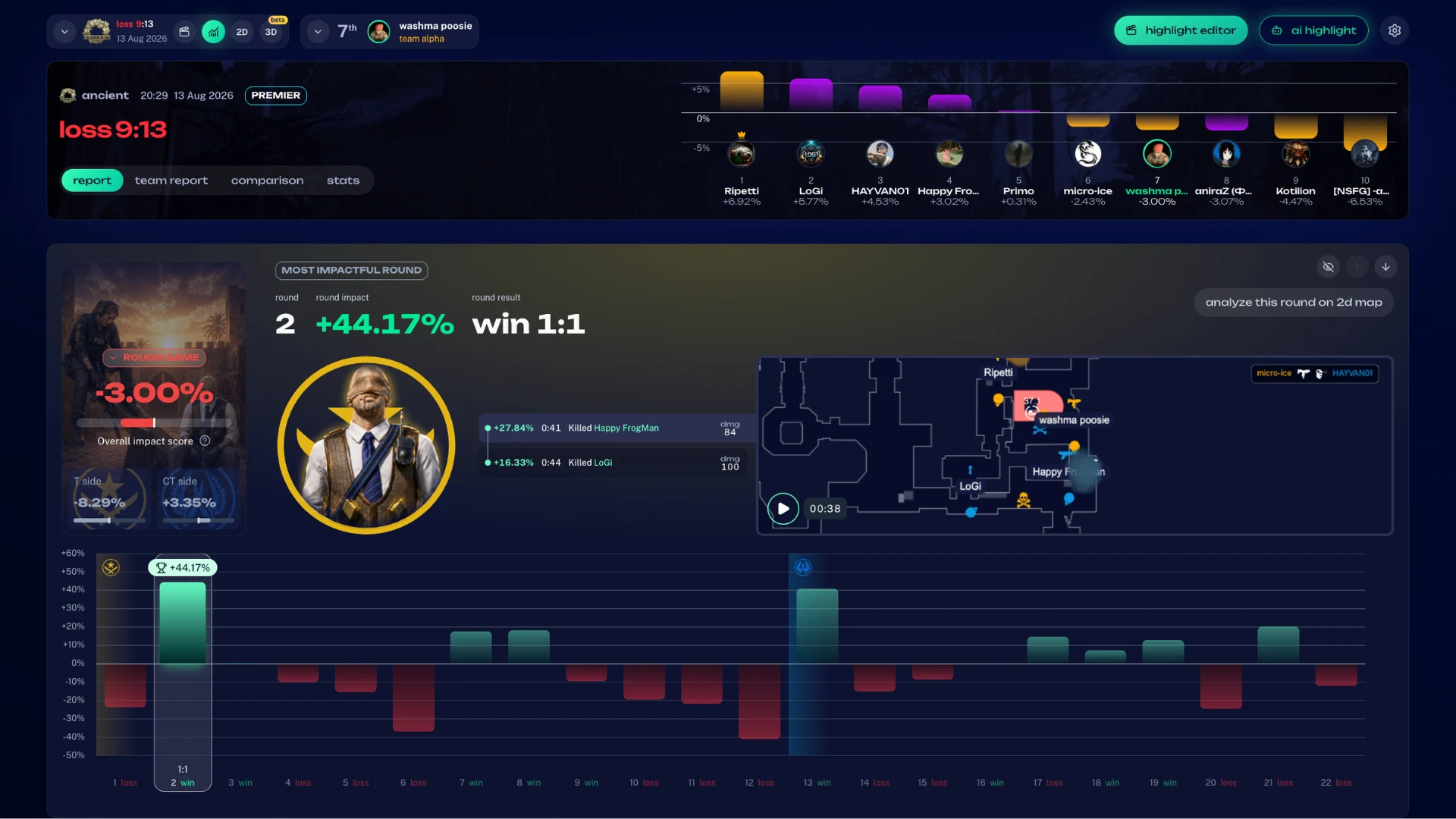
Impact Score measures how much your actions changed your team’s chance to win rounds. It does not only look at kills, damage or K/D. It looks at whether your action, in that exact situation, actually moved the round in your team’s favor - or against it.
Every round, you start with Round Impact at 0%. When your action increases your team’s chance to win the round, your Round Impact goes up. When your action lowers your team’s chance to win the round, your Round Impact goes down.
At the end of the match, your Impact Score is calculated from your Round Impacts across all rounds. In other words, Impact Score shows your average impact per round.
How Round Impact is created
Round Impact is the change in your team’s chance to win the round caused by a player action.
- 48.7%CT chance to win the round at 5v5
- 5v5 → 5v4SirNoobAlot kills micro-ice and deals 100 damage
- 63.4%CT chance to win the round after the kill
+14.7% Round ImpactThe difference of 14.7 percentage points is credited to SirNoobAlot for this event.
The important part is this: impact is not created just because “a kill happened”. Impact is created because the kill changed the state of the round and increased the team’s chance to win it.
The bigger the change in win probability, the bigger the impact. The smaller the change, the smaller the impact. That is why two kills can have completely different value. A kill in a key 2v2 can decide the round. A kill in a round that is already basically won or lost may barely change anything.
How Round Impact becomes Impact Score
Round Impact is calculated for a specific round. Impact Score is the average of your Round Impacts across the whole match.
So Impact Score does not show how much impact you “collected” in total. It shows your average impact per round.
When you see something like Impact Score: +6.14%, it does not mean you played “only 6% better”. It means your actions increased your team’s chance to win rounds by +6 percentage points per round on average.
And that is a lot.
CS2 rounds are often decided by small differences. One opening kill, one bad death, one good trade or one failed post-plant can change the entire round. If a player increases their team’s win chance by several percentage points every round on average, that player had a major impact on the match.
What Impact Score takes into account
Impact Score does not start from an empty table. Not every round starts as a 50/50. If your team has a full buy against pistols, you are naturally more likely to win the round. If you are playing eco against a full buy, you start from a worse position. That matters. The model looks at the round context before and during the action. It takes into account things like team economy, side, players alive, time left in the round, bomb state and time left before the bomb explodes.
This means Impact Score does not only ask: What happened? It also asks: In what situation did it happen?
The same action can have a different value depending on the context. A kill in a 5v5 early-round situation is not the same as a kill in a 1v1 post-plant. A death when your team is up 5v2 is not the same as dying in a key 2v2 retake.
Time is a good example. Before the bomb is planted, time usually creates pressure for the T side because they still need to take space and plant. After the bomb is planted, the pressure shifts to the CT side because they need to retake and defuse. The same kill can therefore have a very different impact depending on when it happens and what the round state looks like.
Alongside round context, the model also evaluates player actions such as kills, deaths, assists, flash assists, friendly fire and damage that leads to kills. The goal is not to reward everything that looks good on the scoreboard. The goal is to measure what actually changed the team’s chance to win the round.
How Impact is split for a kill
When a kill happens, the model first checks how much that kill changed the team’s chance to win the round. That impact is then split between the players who contributed to the kill. The current split works like this:
- 70%
- of the impact is distributed by damage contribution.
- 30%
- of the impact goes to the player who finished the kill.
This means that if one player deals most of the damage and another player only finishes the kill, the full impact does not go only to the killer. The player who prepared the kill gets a meaningful part of the impact too. At the same time, the final kill still matters. Without the kill, the enemy stays alive.
- +10%The kill raises your team’s chance to win the round
- 50 + 50Damage dealt by your teammate first, then by you to finish
- +3.5% each70% of the impact, the +7% damage part, split equally
- +3%30% of the impact as the kill bonus for finishing
+6.5% and +3.5%Round Impact for you and for your teammate. The player who helped create the kill gets credit, but the player who finished it still gets extra impact.
Why 99 damage without a kill may not give impact
This is one of the most common questions. You can deal 99 damage to an enemy and still receive little or no meaningful impact if that player does not die in the round.
At first, that can feel unfair. But in Counter-Strike, a player with 1 HP is still dangerous. They can still hold an angle, hit a headshot and win the round.
Impact Score does not say: “High damage = automatically high impact.” It asks: “Did your action change your team’s chance to win the round?” Damage matters, but damage alone is not always enough. If it does not turn into a kill or a real change in the round state, it may not significantly change the outcome of the round.
Why context matters
Impact Score does not evaluate actions in isolation. It evaluates their effect on the current round state. That is why some kills do not have high impact. If you kill an enemy when the round is already basically decided, you may not change the win probability much. The kill looks good on the scoreboard, but it may not mean much for the actual round outcome.
The same applies to deaths. Some deaths are much more expensive than others. Dying in a 5v2 when your team is still heavily favored may not be that costly. Dying in a 2v2 while holding a key position can be extremely expensive. A death in a post-plant that opens the retake for the enemy team can have a much bigger impact than a normal early-round death.
That is also why a player can end a round with negative Round Impact even after getting two kills. If they later die in a moment where their death heavily reduces the team’s chance to win, the negative part can outweigh the earlier positive impact.
What is a good Impact Score?
Impact Score is always shown as a percentage. It represents your average change in round win probability. As a general guide:
- +5% and above
- Usually means exceptional impact.
- +2% to +5%
- Already means a very strong performance.
- Below -2%
- Usually means your actions were costing your team round win chance.
But the number should not be read completely alone. A player with +1% may have played a solid match in a difficult game. A player with -1% may still have been one of the better players on a team that got stomped. And a player with +6% does not have “only six percent”. They had a very strong average effect on their team’s ability to win rounds.
Impact Score is best read together with context: match result, teammate performance, your long-term average, the rounds where your impact was created and the specific events behind the number.
Negative Impact Score does not automatically mean you were the problem
A negative Impact Score does not automatically mean you were a bad player or that you lost the match for your team. If your team loses most rounds, multiple players will often end up with negative impact. In a hard loss, you can play relatively well and still spend a lot of the match in bad situations where your deaths are expensive.
That is why Impact Score should be compared not only to zero, but also to context. For example, if you have -0.8%, but your team average is -2.6%, you are negative, but you were probably one of the better players on your team. There is a difference between:
- A rough match
- “I had negative impact because the whole match was rough.”
- Costly deaths
- “I had negative impact because I repeatedly died in key situations.”
Impact Score is meant to help you find that difference.
What Impact Score is not
Impact Score is not a replacement for every other metric. It does not tell the full story of your aim, utility usage, communication, space creation or team structure. It also does not mean that one match defines your level as a player. It is one analytical layer. An important one, but still one layer. Its goal is to answer one specific question:
How much did your actions change your team’s chance to win rounds?
The standard scoreboard is bad at answering that. K/D, ADR and kill count often do not show whether your actions came at the right time. Impact Score is designed to show exactly that.
Summary
Impact Score measures your average impact on your team’s chance to win rounds in a match. Every round, you start with Round Impact at 0%. Your actions move that number up or down depending on whether they increase or decrease your team’s chance to win the round.
Your Impact Score is calculated from your Round Impacts across the match and shows your average impact per round.
The calculation uses round context such as players alive, time, economy, bomb state and side, as well as player actions such as kills, deaths, assists, flash assists, friendly fire and damage leading to kills.
It is not about who had the flashiest frag. It is about who actually changed the round.