
A scoreboard tells us what happened. GPRT is designed to understand the structured behavior that led there: the state of every player, the shape of a team and the way a situation develops before the outcome becomes obvious.
Games are more than outcomes
Competitive games generate a dense record of human decisions under pressure. A single Counter-Strike 2 round contains movement, positioning, weapon choices, damage, utility, timing, team coordination and changing risk. These signals are connected, and their meaning depends on context.
Traditional statistics compress that complexity into totals: kills, deaths, damage or rounds won. Those measures are useful, but they describe the result after the fact. They struggle to capture the quieter decisions that made the result more or less likely: a rotation started early, space created for a teammate, an unfavorable duel avoided or a coordinated response beginning to form.
GPRT does not read a match as a table of final scores. It reads it as a structured world changing through time.
GPRT, the General Pretrained Rankacy Transformer, is a domain-specific foundation model built for that world. Instead of processing language, it processes structured match telemetry. Its job is to learn useful representations of players, teams and game states, then use those representations across multiple prediction tasks.
From raw telemetry to training-ready truth
A model is only as reliable as the path its data travels. GPRT is trained through a tiered data architecture that separates source capture from analytical structure and model-ready datasets. Each tier has a different responsibility, and each is a deliberate contract rather than a grade of the same table.
- Bronze preserves
- The source as captured. Nothing is interpreted here, so any later question can go back to what actually happened.
- Silver is reusable
- The match described in one consistent schema. It supports analysis, feature development and many future modeling tasks without parsing the original demo again.
- Gold is intentional
- Datasets assembled for a defined learning objective. Features, labels and dataset versions are explicit, so an experiment can be reproduced and evaluated.
The distinction matters. Training directly on raw or intermediate data can hide changing assumptions inside the pipeline. Restricting model training to Gold datasets creates a stable boundary between data engineering and model development: every training run starts from a known, governed input.
One foundation, two ways to read time
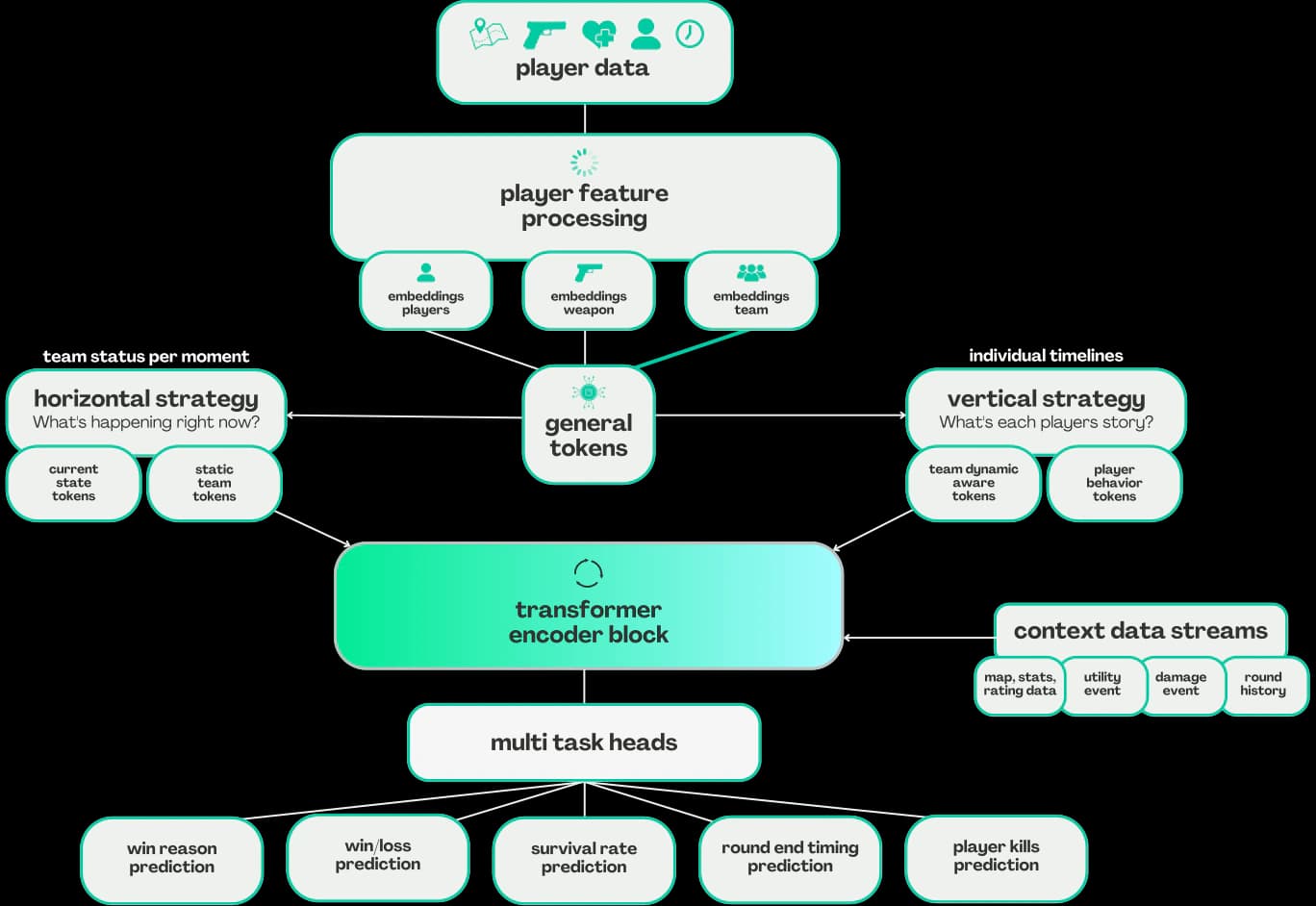
At its core, GPRT transforms match telemetry into embeddings, compact learned representations of players, weapons and teams. It combines those representations with game-state tokens and contextual streams such as map information, statistics, rating data, utility events, damage events and round history.
The transformer encoder learns relationships across those inputs. It can reason horizontally about the state of the match and vertically about the evolving story of each player. This shared foundation powers two variants with different temporal views.
- GPRT Flash
- Analyzes a single game-state snapshot to understand players, teams and match context at one moment. It answers “What is happening now?”, which suits fast state representation and predictions where low latency matters.
- GPRT Pro
- Processes 96 ticks, roughly three seconds, as one continuous sequence. The window lets it capture how player behavior and team dynamics are developing, not merely where they end up. Its question is “How is this situation unfolding?”
Learn once, predict many signals
GPRT is built around a shared encoder rather than one isolated model per output. The encoder first learns a general representation of the match. Multiple task heads then translate that representation into specific predictions.
The current heads predict win reason, win or loss, survival rate, round end timing and player kills. Each task teaches the shared encoder something different about the same underlying situation. This multi-task setup encourages representations that are useful beyond one narrow metric.
The model has reached 75 million parameters across eight encoder blocks and has been trained on 160 million instances. In selected validation tasks it has reported predictive accuracy of up to 90%. That figure is task-specific rather than a universal score, but it illustrates the signal available in structured behavioral telemetry.
Prediction is the layer, understanding is the product
A win probability is useful, but the deeper value of GPRT is the representation behind it. Once the model can encode a player, a team and a moment consistently, the same intelligence can support several product experiences.
- Live match intelligence
- Read the current state, surface momentum shifts and identify decisive moments as they form.
- Performance analysis
- Move from outcome metrics toward the decisions, positioning and context behind performance.
- Player development
- Compare behavioral patterns over time and build feedback around repeatable situations.
- Team dynamics
- Represent coordination and interaction, not only the isolated contribution of one player.
- Content discovery
- Find highlights and high-impact sequences using game context rather than a single event trigger.
- Behavioral research
- Use a measurable digital environment to study decisions, adaptation and performance under pressure.
From telemetry to predictive intelligence
GPRT begins in Counter-Strike 2 because the environment is complex, observable and measurable at scale. It gives us a place to build and validate models that understand behavior as a sequence of contextual decisions rather than a collection of isolated events.
The result is more than another match statistic. It is a foundation for systems that can recognize how people and teams behave, estimate what may happen next and make the path to that prediction easier to understand.