
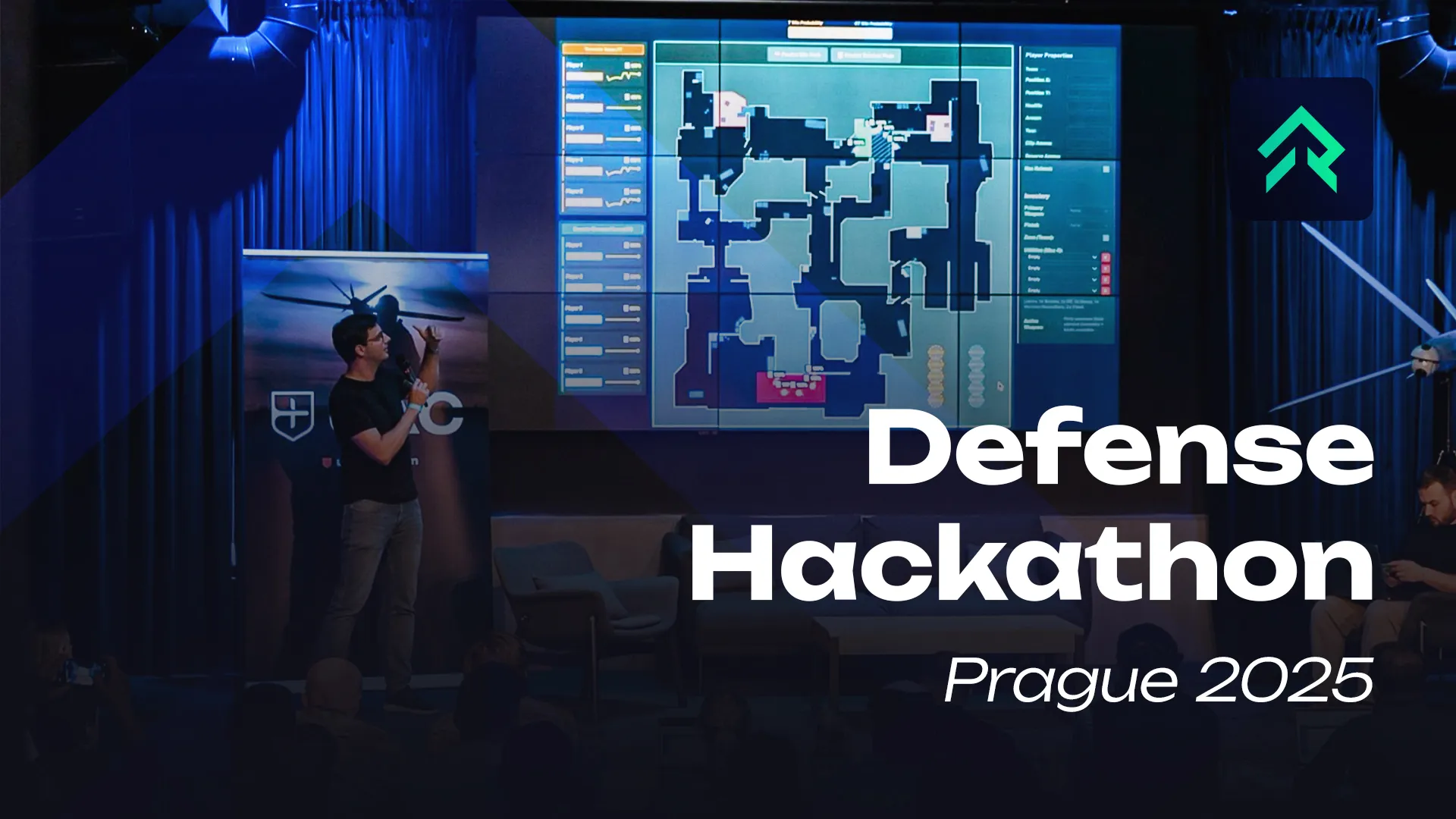
In June 2025 our Rankacy engineers spent a weekend at the European Defense Hackathon in Prague. The brief was simple: take the models we use to analyze behavior in Counter-Strike 2 and see what they do with defense problems.
The same models, a different world
The challenges covered reconnaissance simulations, autonomous drone coordination and tactical decision support. None of them mention a video game. All of them share its structure: agents moving through space, incomplete information, time pressure and a decision that has to be made before the picture is complete.
That structure is what our models are trained on. A Counter-Strike round is a dense record of positions, timing, risk and coordination. Read at that level, the step from an in-game rotation to a simulated route plan is shorter than it looks.
What we built
The team focused on practical outputs rather than concepts. Three tools came out of the weekend:
- Predictive mapping
- Route planning that updates as the situation changes, instead of a plan fixed at the start.
- Behavioral analysis
- Reading how agents in a scenario move and decide, so a threat is flagged earlier than the event itself.
- Real-time data pipelines
- Processing live telemetry fast enough for the output to reach a decision while it still matters.
In the simulated environments these tools shortened response times and improved situational awareness. They were working prototypes, not slides, and they showed that AI trained on gameplay can perform in complex, high-stakes situations.

What the feedback confirmed
The people evaluating the work named three qualities: speed, adaptability and efficient decision-making. Those are the qualities a competitive match rewards. They are also what a defense team needs when the data is live and the scenario refuses to follow the plan.
A model that has learned how people behave under pressure does not care whether the pressure comes from a ranked queue or a mission brief.
Why it matters to us
Gaming is our research environment, not our end goal. Competitive play gives us a measurable world at scale, and the point is to carry what we learn there into environments where the stakes are real. Prague was the first time the same framework ran in both worlds in the same weekend, and it held.
Emanuel presented the results on behalf of the team.
