
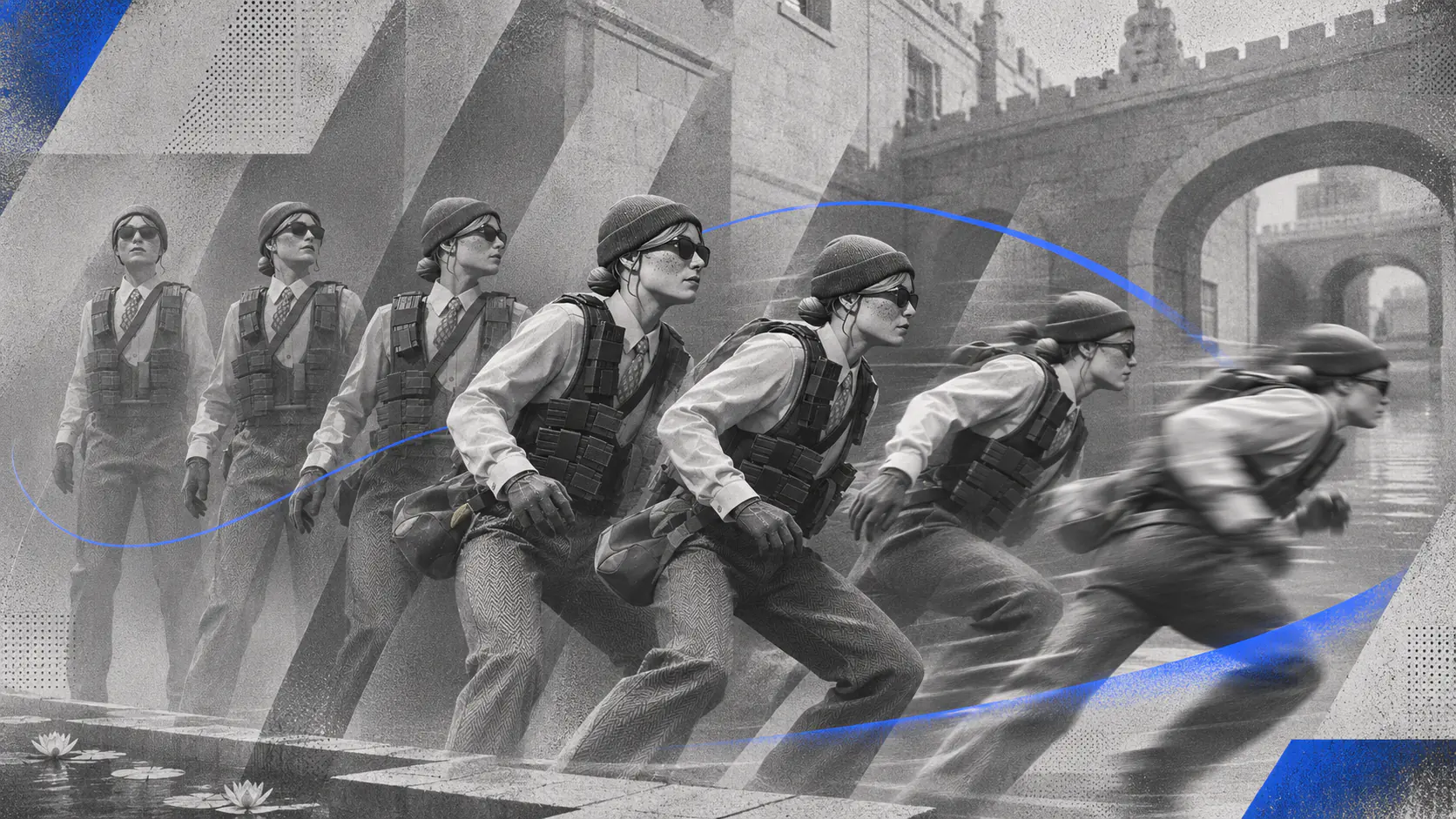
You turn a corner on Mirage and an enemy is already there.
There is no time to list the options. Your weapon, position and the space around you have already shaped the decision. You take the fight, or you break away.
A moment later, the scoreboard may record a shot, a kill or nothing at all. But the decision happened earlier, inside a fraction of a second that ordinary match statistics never see.
Orbit was built to read that moment.
It looks at 109 milliseconds of a recorded Counter-Strike 2 match—the final seven ticks leading into a player's reaction—and predicts what follows: fight or flight.
The decision hidden between the events
Scoreboards are good at outcomes. They tell us who fired, who died and which team won. They say much less about the decision that came first.
A player who retreats and survives leaves no obvious mark in the match summary. A player who takes a duel and loses is recorded as a death, but not as a decision to stand their ground. Studying those choices requires a different unit of measurement: the moment when a player first responds to a threat.
We identified more than 271,000 reactions across nearly 32,000 recorded matches. Each begins at an anchor—the instant a player suddenly changes how they turn or move after encountering an enemy. Orbit sees only the sequence up to that anchor. It never sees what the player does afterwards.
Reading a match like a sentence
Orbit is a transformer, the same broad family of neural-network architecture used by modern language models. A language model reads a sequence of words. Orbit reads a sequence of game moments.
Counter-Strike records the match 64 times every second. At each tick, Orbit receives 152 pieces of information describing the situation: the player's position, movement, health, weapon and crosshair; the locations of teammates and enemies; and the state of the round.
The model turns every tick into a token. Attention lets those tokens be interpreted together, so a weapon, a nearby enemy or a particular part of the map gains meaning from the rest of the situation. The complete model has about two million parameters—small by modern AI standards, but enough to test whether a sequence model can recognise the structure behind a fast human reaction.
Orbit does not read thoughts. It reads the situation in which a reaction begins.
A tenth of a second was enough
We expected a longer history to help. A player's response might depend on how they entered the area, where their teammates moved or what happened earlier in the round. We trained six Orbit models with look-back windows ranging from 109 milliseconds to three seconds.
The shortest window matched or outperformed every longer version. In the sampled validation used to compare windows, seven ticks reached 71.5% accuracy and three seconds reached 69.8%. The selected seven-tick model later reached 71.2% on the full validation set described below. The useful signal was already present in the immediate situation.
Learning the meaning of the map
Position in Counter-Strike is not just a pair of coordinates. Two locations separated by a few metres can imply completely different options if a wall, doorway or change in elevation lies between them.
We divided the competitive maps into 9,216 squares and taught a separate model how those squares relate by observing real player movement. Much like a language model learns meaning from the words around a word, the map embeddings learn which areas players move between and how locations function inside a match.
Removing the map information reduced accuracy by about 2.7 percentage points. The strongest individual clue was even more immediate: the weapon in the player's hands. A choice made before the encounter often shapes the reaction that follows it.
Testing Orbit on unseen matches
We split the data by complete matches, never by random rows. Orbit trained on more than 230,000 reactions from 27,000 matches, then faced about 41,000 reactions from another 4,800 matches it had never seen.
On those matches, Orbit predicted fight or flight correctly 71.2% of the time. Always choosing the more common answer reached 51.8%. The more confident Orbit became, the more often it was right: on the most confident sixth of reactions, accuracy reached 92.9%.
We also removed ten players from training entirely. On 1,352 reactions from those held-out players, accuracy remained at 71.3%. It is a small test, but it suggests Orbit learned recurring situations rather than simply memorising particular people.
The label is part of the experiment
There is no fight-or-flight field inside a match recording. A transparent scoring system created the labels from what the player did after each reaction. Moving towards the enemy, aiming and firing counted towards fight. Moving away, switching to a knife or breaking line of sight counted towards flight.
Seven people independently reviewed the same 200 reactions. On the basic fight-or-flight question, pairs of annotators agreed about 85% of the time. Where a clear majority formed, the automatic label matched their consensus 82% of the time.
Some reactions are genuinely difficult to classify. Orbit reaches 79.3% accuracy on the clearest quarter, but only 57.8% on the most ambiguous one. The model is measured against a consistent behavioural definition, not perfect human ground truth.
A transformer did not win every number
Orbit is not the most accurate model we trained for this task. EMBER, a gradient-boosted tree model using engineered features, reaches approximately 73.5% accuracy. It is the stronger specialist today. Orbit tests a different idea: whether a transformer can learn directly from the sequence of match states and build representations that can support more than one narrowly engineered prediction.
Orbit also predicts a behaviour label, not a player's thoughts or intentions. The flagship model is designed for offline analysis of recorded matches, not as a live assistant or game-playing bot. Those limits do not erase the result. They define it.
The moment before the gunfight
Back on Mirage, the enemy is still in the doorway. Seven ticks contain almost no story in the usual sense. But they contain a situation: a weapon, a position, an angle, a distance and the changing relationship between ten players.
Across hundreds of thousands of reactions, those situations were structured enough for a compact transformer to learn from them. A tenth of a second did not reveal what the player was thinking. It revealed that the moment itself already carried part of the answer.