
You're walking down a quiet street in the evening. Suddenly, a hand grabs your shoulder from behind.
You don't decide what to do. Your body does. Some people spin around to face whoever is there. Others jump away first and look later. Only after that do you actually start to think.
Players in Counter-Strike 2 live a version of that moment again and again. A shot hits them from behind, from someone they can't see. They have a fraction of a second: turn and fight, or get out.
Can you tell how a person reacts in that moment from game data alone?
Our new research paper says yes, most of the time. Small, fast models that read game telemetry directly can predict fight or flight in less than a millisecond, before the reaction is visible. The dataset we built for them carries a clean, learnable signal, and its labels hold up against human experts.
Toward Fast Human Reaction Modeling from High-Frequency Digital Interaction Data presents the full method, results and limitations.
The data sees everything. The player doesn't.
A match recording knows everything: where every player stands and where every bullet goes, 64 times every second.
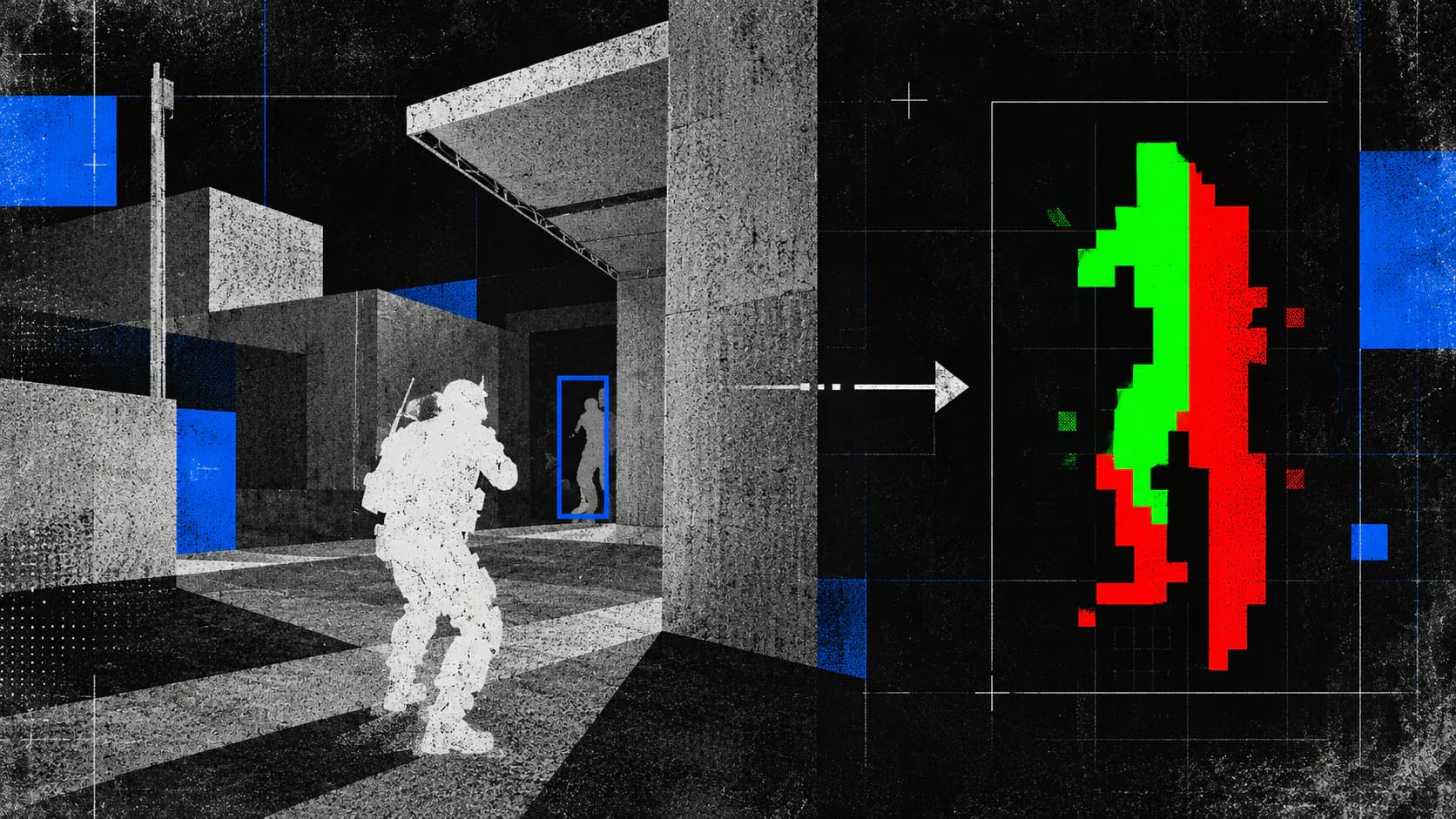
The player knows far less. They see only what's in front of them, through smoke, around corners and past walls. A model trained on the full recording could predict well and still be completely unlike a human, because it would be using information no player ever had.
Before predicting anything, we rebuild what each player could plausibly perceive at each moment. We call it Ego-Knowledge.
The research paper explains how we rebuild it, down to the pixel.
Two models, two bets
We trained two models to answer the same question, using only what was known up to that moment.
- EMBER
- The pragmatic one: a lightweight, classic machine-learning method (gradient-boosted decision trees). Small, fast and cheap to run.
- ORBIT
- The ambitious one: a neural network of the same type that powers modern AI language models (a transformer), built to read the situation moment by moment.
For now, EMBER comes out slightly ahead. ORBIT is our long-term bet: one model for many behavioral tasks, once it has far more data to learn from.
A dataset that holds up
We searched 32,205 recorded matches for these moments: an enemy suddenly coming into view, or a hit out of nowhere. That gave us 271,541 moments from 119,149 players, each labeled fight or flight from what the player did next.
To check the labels, seven annotators with deep knowledge of the game reviewed 200 situations where a player was shot from behind. Where most of them agreed, the automatic label matched in 80.6% of cases.
The data passed the other tests, too. EMBER, the simpler model, trained stably without any tuning and converged reliably, run after run. On the situations the experts had labeled, it was right in 74.8% of cases, in line with its 73.5% on the full validation set. And the models still worked on players they had never seen: EMBER reached 71.4% and ORBIT 71.1%. They learn how people react under pressure, not the habits of specific individuals.
The signal is in the data. A small model is enough to read it.
Small, fast and ahead of language models
The first test asked the models to predict fight or flight before the reaction itself was visible.
| Model & configuration | Accuracy | Avg. time | Cost / 1,000 |
|---|---|---|---|
| EMBER*Gradient boosting · Mesocort AI | 73.5% | 0.00001 s | $0.000002 |
| TabPFN v3.5*Pretrained tabular model · Prior Labs · Full context (200,000+) | 73.5% | 0.215 s | $0.0429 |
| ORBIT*Transformer · Mesocort AI | 71.2% | 0.00034 s | $0.000062 |
| Jev (Score)Decision model · TypeSafe AI · Narrative, 20 features (104) | 63.4% | 0.48 s | $1.27 |
| Gemini 3.7 FlashMedium · Narrative (1/8) | 62.7% | 1.81 s | $4.70 |
| GPT-5.6 TerraMedium · Narrative (1/8) | 61.8% | 1.42 s | $14.21 |
| Gemini 3 FlashMedium · Compact (3/4) | 61.1% | 4.74 s | $23.64 |
| Qwen 3.8 27BFull-Dump (32) | 59.9% | 1.13 s | $4.85 |
| Qwen 3.5 9BFull-Dump (32) | 59.4% | 0.82 s | $1.72 |
| Qwen 3.5 9BNarrative (32) · Fastest and cheapest LLM run | 59.0% | 0.48 s | $0.64 |






Task: predict fight or flight using only information available up to the trigger. Language models and Jev use 1,000 validation situations. EMBER, ORBIT and TabPFN use the full validation set; on the same 1,000 situations EMBER and ORBIT reach 73.6% and 70.9%. Cloud and local timing and cost are not directly comparable. Source: Table VII of the research paper.
Both of our models answer in less than a millisecond: EMBER in about 0.01 milliseconds, ORBIT in 0.34. They read game telemetry directly, the raw record of every player in every moment. Large language models (LLMs) such as GPT, Gemini and Qwen read a text description of the same situation instead. They needed between half a second and almost five seconds per answer, and they were less accurate. On the same 1,000 situations used to test the LLMs, EMBER reached 73.6% and ORBIT 70.9%, and the gap held up in statistical tests.
One strong alternative does keep up on accuracy. TabPFN, a pretrained model built for tables of data, matches EMBER at 73.5%. The difference is in what it costs to get there: ORBIT answers roughly 630 times faster and about 690 times cheaper than TabPFN, and EMBER is faster and cheaper still.
Side by side, the numbers look like this:
- About 1,400 times faster
- ORBIT took 0.34 milliseconds per prediction, compared with 480 milliseconds for the fastest language-model run.
- About 10,300 times cheaper
- ORBIT cost $0.000062 per 1,000 predictions, compared with $0.64 for the cheapest language-model run.
- +10.9 percentage points
- EMBER reached 73.6% against 62.7% for the best language model (Gemini 3.7 Flash), on the same 1,000 situations.
- About 630 times faster than TabPFN
- ORBIT took 0.34 milliseconds per prediction, compared with 215 milliseconds for TabPFN at its full context, and cost about 690 times less.
This is not a perfectly even comparison. The language models ran in the cloud with network delays included, while ORBIT ran locally. It still shows what running this kind of model in practice looks like.
Then we let ORBIT see the first moments of the reaction. Its accuracy climbed steadily to 85.15% after about one second. Part of that is expected because the label is defined by the reaction. The shape of the climb may show a handover from a fast response to slower, deliberate control. For now, that is a hypothesis, not a result.
ORBIT · Early response recognition
From prediction to recognition
Across 17 tested windows, accuracy rises monotonically from about 70% at the trigger to 85.15% after roughly one second.
85.15%at ~1 second
Seventeen tested windows show ORBIT accuracy rising monotonically from about 70% at the trigger to 85.15% after approximately one second.
Why language models hit a ceiling
The best language model in this benchmark reached 62.7%. A previous generation, tested earlier, reached 63.5%. Newer models did not move the needle.
That points to the format, not the model. Turning a stream of numbers into sentences discards the fine timing and geometry that decide these moments. The language models also kept falling into the same trap: an enemy is close to the crosshair, so the player must be about to fight.
Some moments are hard for any model. On Mirage, a player holding an AK-47 rifle is exposed to an opponent with an AWP sniper rifle in a window. The sniper holds a strong angle and can step back, reload and peek again after a miss. ORBIT predicted that the player would withdraw. The player took the fight anyway.
The geometry and the weapons said "leave". The person said "go".
Decisions like that depend on things the data captures only partly, including how much risk a player is willing to take.
What we don't claim
The research paper borrows words from neuroscience, including "fight or flight" and "limbic-like". That vocabulary shaped what we measured and where we looked, but it is not a result. Nothing here measures the brain. Behavior alone cannot distinguish a primal reflex from a well-trained habit.
The labels have limits, too. Even our expert annotators agreed only moderately with each other. That shows how ambiguous these moments are and caps what any model can achieve against them. The labels also come from the same telemetry the models read. The expert check reduces that problem but doesn't remove it, and so far it covers only one type of moment.
This is Phase 1: one game, one carefully filtered type of situation, results measured on the same data we used to choose the models, and no reconstruction of sound yet. It proves the approach works, not a final number.
What's next
In Counter-Strike, you often hear an enemy before you see one. The next layer of Ego-Knowledge is sound: footsteps, gunfire and reloads.
Then comes scale. This study used a deliberately small slice of our data. Our infrastructure has already processed more than 4.5 million match recordings. The goal is a foundation model that learns from game telemetry on its own and serves many behavioral tasks at once.
The same approach could leave gaming behind and apply to telemetry from driving simulators, surgical training or virtual reality (VR). Together with academic partners, we want to pair it with physiological measurements such as brain activity (EEG) and eye tracking to test what behavior alone cannot prove.
Back to that hand on your shoulder
We are building a frontier AI lab to model and predict how humans react and make decisions under pressure.
The moment someone grabs your shoulder lasts less than a second. This research paper is our first step toward understanding what happens inside it, one reaction at a time.
Reference: Dopater, E. et al. (2026). Toward Fast Human Reaction Modeling from High-Frequency Digital Interaction Data. arXiv:2610.35079