
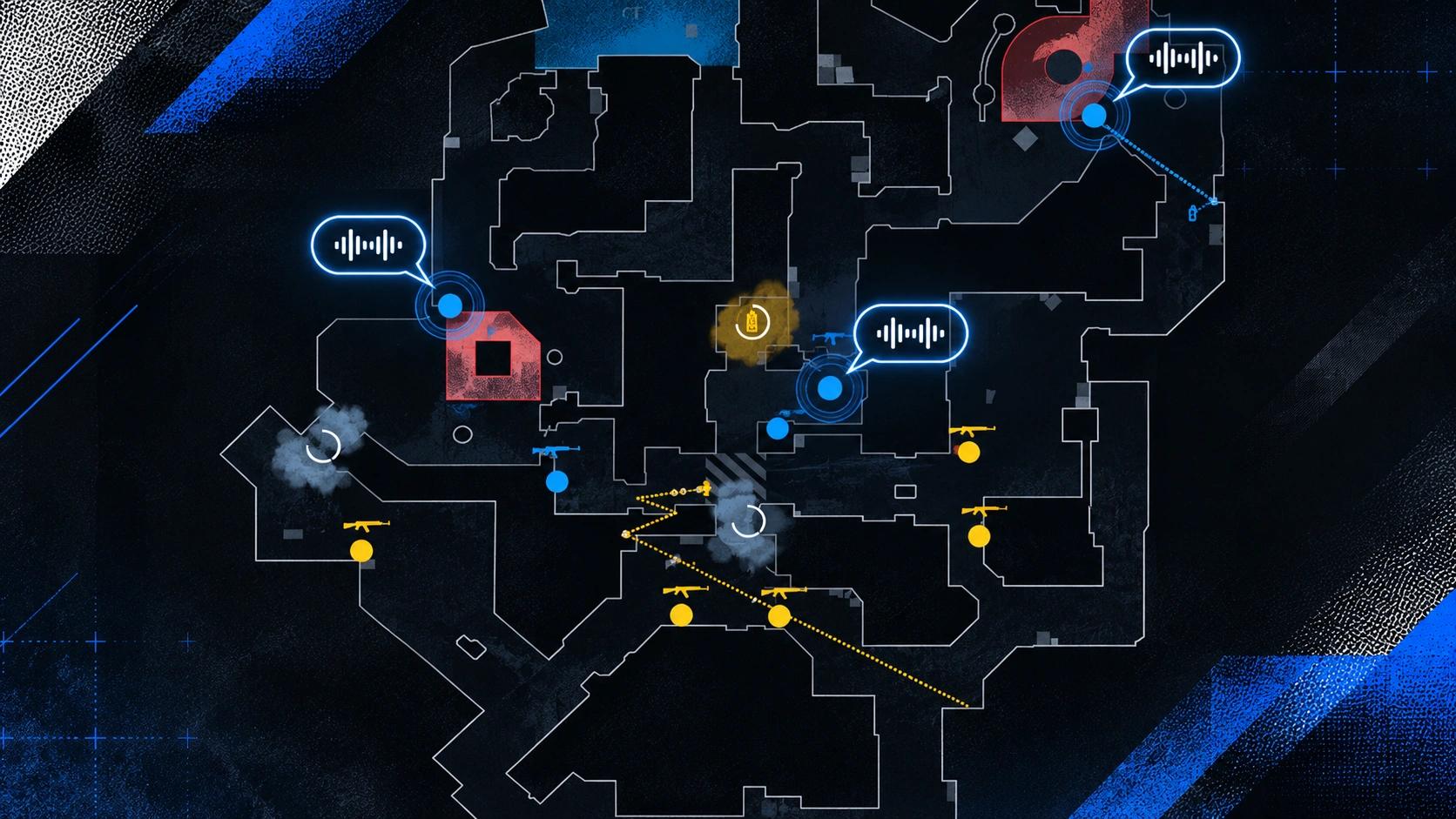
The clock started with an uncomfortable amount of data and one question: what happens after someone speaks?
We had recordings from 14 Counter-Strike 2 matches: 340 rounds, 110 players and 240 minutes of voice chat. The game itself had recorded every position, shot, grenade and death 64 times per second. Somewhere inside all of that were thousands of tiny decisions made under pressure.
The voice was the messy part. Most messages lasted only a second. Players talked over gunfire, swallowed half their words, switched languages and used names for places that do not exist outside the game. “Long.” “One Short.” “Molly.” To a teammate, each fragment could change the round. To a normal speech model, it was noise.
We had 48 hours to make the noise mean something.
First, we had to put every word on the clock
A transcript alone would not be enough. We needed to know exactly when every word was spoken, where the speaker was standing and what the rest of the team could see at that moment.
The first layer turned the audio into timed words. We taught it 48 named areas on Dust II so that “Long” stayed a place instead of becoming an ordinary adjective. The next layer read the conversation and pulled out reports, questions, instructions, plans and corrections. Then we placed those events on the same timeline as the match.
For the first time, a sentence such as “one Lower” had a position, a speaker and a reality it could be checked against. We could follow a request for a grenade into the next ten seconds and see whether a teammate threw one. We could watch a warning arrive and then watch a player turn toward it.
That was the first real breakthrough. The voice was no longer floating beside the game. It was inside it.
Then the map began to talk
By the second day, the pieces were becoming an application. We called it ECHO.
On screen, ten players moved across a 2D map while their real voices played in sync. Words appeared as they were spoken. Tactical calls landed on the places they described. Markers showed moments of anger, profanity and uncertainty. A small graph moved with the conversation, estimating which team might win the round from the voice chat alone.
Behind that screen were nine analyses, several language and audio models, one graphics card and a growing collection of cached results that saved us from paying twice every time something broke. But none of that was the point. The point was that we could finally press play and experience the round through both the map and the team’s conversation.
Then we reached the moment that made ECHO feel real.
A player said, with complete confidence, “He’s full HP.” ECHO checked the call against the match. The last opponent had 15 health points left.
In another round, someone reported an enemy in Lower Tunnels. Six seconds later, the same voice returned: “Maybe I misheard.” On the screen, we could watch information enter the team, shape the moment and then get pulled back. A transcript would show two sentences. ECHO showed the story between them.
Once we could see those stories, we started looking for more. They were everywhere.
The last surviving player stayed silent in 90% of those situations. The dead teammates kept talking.
Players swore seven times more often after dying, usually within 2.2 seconds. Yet sentences that named a place on the map contained four times less profanity than everything else. When people focused on useful information, the noise dropped away.
We found 123 requests for grenades. In 45 cases, a teammate threw one within ten seconds. And in one early experiment, a model that saw only the conversation became better than chance at guessing the winner during the second half of the round. The sample was too small to publish an accuracy number, but the signal was there.
A team’s voice carried far more than locations and instructions. It carried confidence, confusion, pressure and the shape of a plan changing in real time.
The clock stopped. ECHO kept going.
Forty-eight hours earlier, we had a pile of audio files and game logs. Now we had a working replay where you could hear a call, see the world around the speaker and follow what the team did next.
It was still a prototype built from 14 matches. The labels were automatic and many moments still needed a human to judge them. ECHO could not read minds, detect lies or explain why somebody acted. It did something simpler and, to us, more exciting: it put communication beside reality.
Counter-Strike was the perfect place to try it because every action is recorded and every player sees only part of the situation. But that is not just a gaming problem. Emergency crews, dispatchers and other teams under pressure also depend on words to move information between people who see different pieces of the world.
For two days, we watched voice chat turn from sound into text, from text into events and from events into a living replay of a team thinking together.
Voice is intelligence. In 48 hours, we built a way to watch it move.
The findings in this article come from an exploratory 48-hour project using 14 Counter-Strike 2 matches on Dust II. Unless stated otherwise, the labels were generated automatically and have not yet been validated against human review. They show associations, not causes.