
Nobody learns to drive alone.
On your first lesson, there's an instructor next to you with a second brake pedal. They've driven the route a thousand times. They tell you to slow down before you even see the bend. And if something goes wrong, they're already on it.
Now picture something far harder, with nobody in that seat.
Your first lap
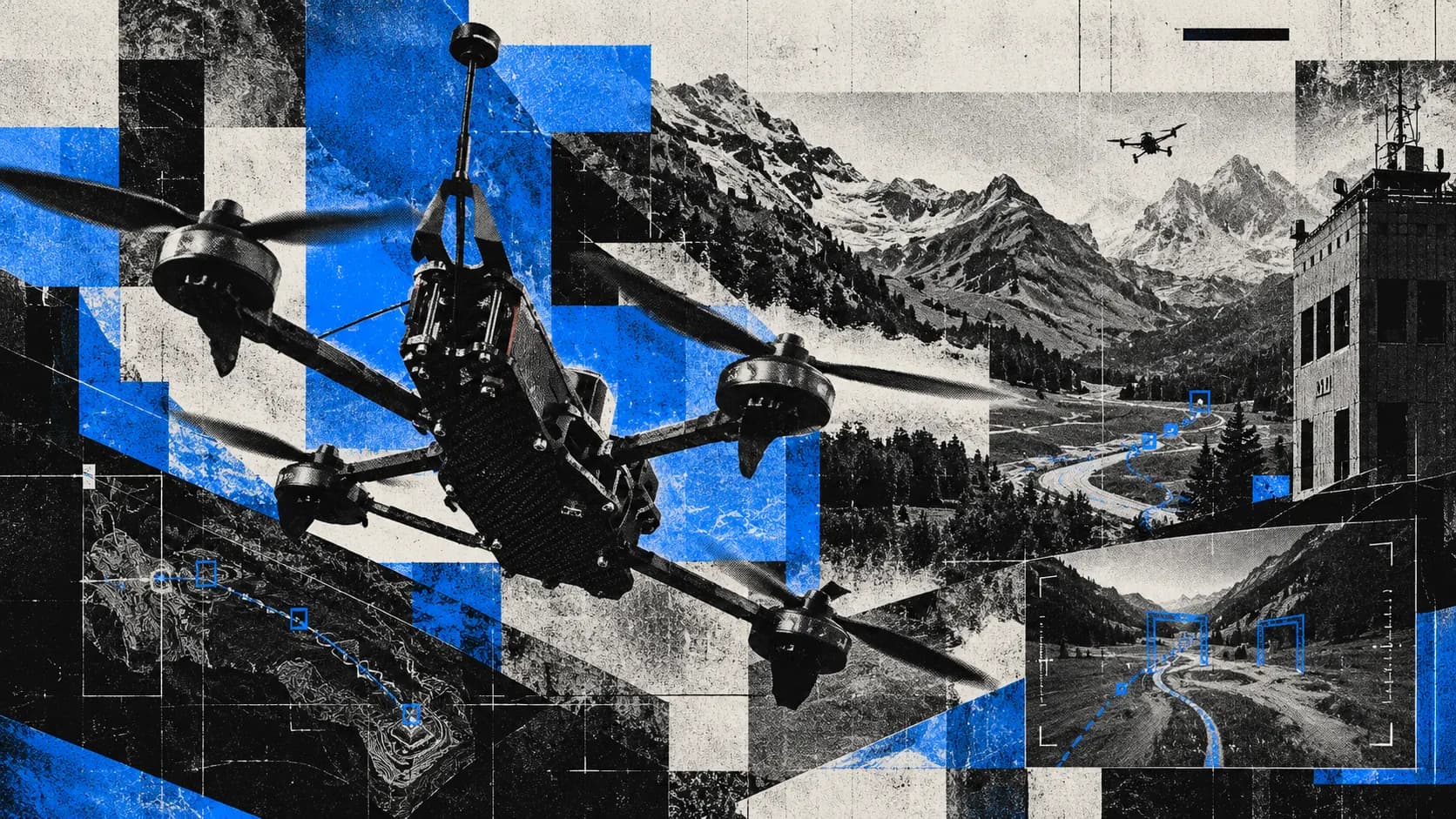
Two sticks. Four things to control at once: throttle, roll, pitch and yaw. On the screen, an FPV racing drone waits in front of the first ring.
You take off. The drone tilts, and when you let go, it doesn't level itself. It just keeps going at whatever angle you left it. You correct, overcorrect, and the ring flashes past on the wrong side.
At 30 metres per second, a drone covers 9 metres in the 0.3 seconds it takes you to react. By the time you understand what went wrong, you've already crashed.
Crash, restart, repeat. That's how most pilots learn FPV, with no one to show them what their sticks should have been doing.
Same lap, with an instructor
That empty seat is why we built Falcon: a coach that flies the course first, then teaches you to fly it.
You try the same lap again in the simulator. This time, a second pair of sticks appears on screen next to yours. 25 times a second, Falcon works out how the drone should be flown through the next rings, and these ghost sticks show you the clean line, live. All you have to do is match them.
Still too much? Hand over one stick. Falcon flies one, you fly the other, and you learn the controls half at a time. Want to see it done first? Falcon flies the whole course and lands, like an instructor driving the route once before handing you the wheel.
And the second brake pedal is always there. You take off yourself, one key hands every stick back to you instantly, and your mistakes never end the session. That's what practice is for.
It flies at your pace, not its own
A racing autopilot chases the fastest lap. Falcon chases a line a person can learn from.
On one training course, 30 m/s turned out to be simply too fast for a human to follow. So when Falcon coaches people there, it slows to around 15 m/s. Its own commands get the same treatment. A raw computer command is far too sharp for any person to follow, so Falcon smooths it into a cue you can match. It even allows for your reaction time and shows you what to do at the moment you'll actually respond.
Before any pilot sees a new version of that guidance, a robot takes the lesson first: a bot with human-like reaction time that follows the cues. On one course, it started out passing 1 ring in 10. The fixes it helped us find took it to all 10.
How it sees the bend coming
Every instructor takes a new car around the block first. Falcon does too. One short test flight per drone, and it builds a physical model of how that drone climbs, turns and fights the air. It doesn't guess. It measures.
Before the run, it plans the right speed for every point of the course, so it knows where to brake long before the corner. During the run, it keeps thinking ahead. Using Model Predictive Contouring Control, from the same family of methods research labs use for near-time-optimal racing drones, Falcon imagines the next 0.8 seconds of flight, picks the best stick moves, uses only the first, and starts again with fresh data.
25 times a second. Each decision takes a median of 17.8 milliseconds, on an ordinary computer processor. That's the difference between reacting and anticipating.
Steady enough to follow
On its own, the autopilot has flown a large 10-inch drone at up to 206 km/h. In one test, it flew three laps in a row within 0.18 seconds of each other.
For a coach, the second number matters more. A line that's the same every time is a line you can learn.
44 days of practice in 15 minutes
To improve faster, we built Falcon a digital twin: a fast copy of the simulator's flight behaviour, made from our recorded flights. 100 million decisions would take about 44 days in real time. In the twin, they take about 15 minutes.
The twin has one blind spot: no buildings. Once, a route planned there flew the drone straight into one behind the start in the real simulator. Lesson learned. Nothing counts until it works in the real simulator.
The empty seat
We help people improve performance under pressure. Few things test that like a drone racing through rings at over 100 km/h, where a split second decides the run.
Falcon puts an instructor in that empty seat. One that has already flown the line, sees the bend coming, and keeps a foot over the second pedal while you learn to fly it yourself.